

OWNER-DRIVEN BY DESIGN
Every IC yacht is designed around the assumption that it will be operated by its owner.
Not by permanent crew. Not by charter staff. By the person who chose to own.
This drives:
-
system logic and accessibility
-
deck ergonomics for short-handed sailing
-
rational sail-handling geometry
-
serviceable technical spaces
-
structures engineered for fatigue life, not cosmetic mass
On IC36, this is expressed through extreme functional reduction.
On AION, through intelligent integration.
On KAIROS, through precise control of high performance.
Owner-driven does not mean simplified. It means optimized for understanding, control, and long-term operability.
PERFORMANCE MUST WORK FOR THE SAILOR, NOT AGAINST THEM
DESIGNED FOR THE WAY BOATS ARE ACTUALLY SAILED
Many performance multihulls are conceived around impressive numbers, large crews, or idealised conditions.
But offshore, reality looks different.
Long days, changing weather, limited crew, fatigue, and the need to make clear decisions without unnecessary complexity define how a boat is truly sailed.
Owner-driven design starts with acknowledging this reality.
It places the sailor — not the specification sheet — at the centre of every design decision.

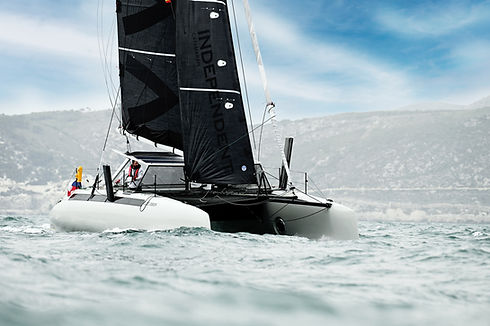
PERFORMANCE MUST WORK FOR THE SAILOR, NOT AGAINST THEM
PERFORMANCE SHOULD REDUCE WORKLOAD, NOT INCREASE IT
High performance is often associated with higher demands on the crew.
More sail changes. More systems. More complexity.
For an owner-driver, this approach quickly becomes unsustainable.
An owner-driven performance cruising catamaran is designed to:
-
remain manageable with a small crew
-
reduce physical and mental workload
-
allow confident operation in changing conditions
-
keep control intuitive and predictable
Performance should work with the sailor, not require constant effort to manage it.
PERFORMANCE MUST WORK FOR THE SAILOR, NOT AGAINST THEM
ERGONOMICS, VISIBILITY AND CONTROL
True control offshore is not only about speed or power.
It is about how easily the sailor can read the boat and the conditions.
Owner-driven design prioritises:
-
clear sightlines from the helm
-
logical deck layouts
-
efficient line handling
-
systems placed where they can be understood and reached
When information, controls and feedback align naturally, decision-making becomes faster and calmer — especially when conditions deteriorate.


PERFORMANCE MUST WORK FOR THE SAILOR, NOT AGAINST THEM
CONFIDENCE WITHOUT CREW DEPENDENCY
Many modern multihulls deliver impressive performance — as long as they are sailed by a full, experienced crew.
Owner-drivers need something different.
They need a boat that:
-
remains balanced across a wide sail range
-
forgives minor mistakes
-
does not rely on constant trimming to stay safe
-
inspires confidence, not tension
-
Owner-driven performance is about margin — margin of safety, margin of control, margin of energy at the end of the day.
PERFORMANCE MUST WORK FOR THE SAILOR, NOT AGAINST THEM
DESIGNED FOR LONG DAYS OFFSHORE
Offshore passages are not won in the first hour.
They are shaped over long days and nights, where fatigue accumulates and small inefficiencies grow into real problems.
An owner-driven multihull must:
-
sail comfortably for extended periods
-
minimise physical strain
-
reduce noise and vibration
-
remain predictable when conditions change
These qualities are rarely visible in marketing images.
But they define whether a boat is enjoyable — or exhausting — to own.


PERFORMANCE MUST WORK FOR THE SAILOR, NOT AGAINST THEM
WHY OWNER-DRIVEN DESIGN IS A CHOISE
Owner-driven design is not a default.
It is a deliberate decision.
It often means saying no to:
-
unnecessary systems
-
features that add complexity without real benefit
-
design trends that prioritise appearance over function
In return, it delivers clarity, confidence, and a deeper connection between sailor and boat.
PERFORMANCE MUST WORK FOR THE SAILOR, NOT AGAINST THEM
OWNER-DRIVEN BY DESIGN AT INDEPENDENT CATAMARAN
Independent Catamarans are conceived for sailors who intend to sail their own boats.
Weight discipline, balanced sail plans, intuitive deck layouts, and restrained systems are not compromises — they are intentional choices.
Because true performance is only meaningful when it remains accessible to the person at the helm.


